Blog Archive

Monday, 5 February 2018

Power back to the people


The revolution about giving back power to people.

History has told us that powerful people always had control of the  masses.

From Kings and  Queens  , from politicians to dictators, from individual business people to corporate organisations. All of them have controlled masses, land and resources. They have controlled production and distribution of goods, control and  distribution of food, control and distribution of energy. And they still do.

Nowadays other controls are taking place in our society. The control and distribution of facts, the control and distribution of gadgets , electronics and communication systems.

Since the advent of television the manipulation of masses has worsened. If in the past slavery was the ownership of the individual body and power of a person, nowadays slavery has taken away the minds of the people. No need for a war to control millions if not billions of people. All is done in a very subtle way. The brainwashing machine(s) are at work on a daily basis, but in such a way that nobody notices it. Day by day, year by year these machines are controlling, teaching people how to be subservient to the capitalistic system, which ( needs) has the needs of people in order to survive.

The system is created in such a way that can only be fed by its own people producing goods and the very people consuming them. The beneficiaries are the organisations who control the people. Politician are at the mercy of these organisation and therefore the legislation created by them are there to keep the productive machine going and the organisations happy.

We now live in a word where an individual can earn thousands of pounds a day and at the same time millions cannot eat a meal on a daily bases. The individuals who earn so much cannot never spend that money and the others cannot never earn  it in their lifetime. The accumulation of money and power from some individuals are the main causes of the problem the planet is suffering and from which is dying slowly. The re-distribution of these powers through the creation of goods such mobile phones( for example), makes all of us responsible of the destruction of the planet for the benefit of few.

This complex mechanism is so intricate in its ramification of multiple mechanism that is difficult to be understood. This is way everything we do  today in our routine life has consequences for the planet, but we do not realise it. The way we travel, we wear, we wash, we eat, we consume and so on only takes  away resources without  putting anything back. Even our pee and solids are not recycled and we know now that they are  precious resources for creating compost or energy.

As human we are the worst specie for inefficiency. Our greed is so monstrously big that now we are using three times more the resources available from our planet. The point is that this way of life has privileged some people to the expenses of others. And to be honest, a minority of people in this world are exploiting the majority of the rest without knowing it. When we buy a mobile phone, do we know where really comes from? Do we know who has been exploited and how many? Do we know that some wars are part of the control of the minerals need it for these gadget?

There are many points of discussion. Take for example clothing. We buy cheap clothing because they were made on cheap labour in poor countries. We spoil our children by exploiting others mother’s children. But this is not the end of it. We buy so cheaply that we then through away lots of these  items to buy more. In the past old clothes were mended, passed onto friends or family or given to charity shops.

But in an age of "fast fashion" people dump 500,000 tons of clothes in landfill every year - compared to the two million tons bought in shops. But numbers here are irrelevant, as it is the action of waste that is worrying. People just do it without thinking or think that is Ok to do so. Wrap research  found that Scottish, Welsh and northern Ireland  in the last year alone left a staggering 1.7 billion items unused in our wardrobes”. But the sad thing is , in the countries were the cloths are produced for us the people over there have little clothing to wear.

The concept of “ sustainability” I think is now abused and inefficient, both in practical terms and in intellectual terms. We need urgently to shift to a major approach which will imply a radical change in our way of life. The thinkers behind a revolutionary change are there but political establishment and powerful corporation will try to boycott their concepts to be out  and available to people. People themselves need to be re-educated and this is a massive task for any courageous politician who want to try to implement it.

“De-growth”. This is the only way we can save our planet and future generations. In the short term, the application of this concept will avoid  the misery of millions of people and many wars which are design to control the resources in the planet.

As Wikepedia described at the beginning of the page: Degrowth is a political, economic, and social movement based on ecological economics, anti-consumerist and anti-capitalist ideas.

“The contemporary degrowth movement can trace its roots back to the anti-industrialist trends of the 19th century, developed in Great Britain by John Ruskin, William Morris and the Arts and Crafts Movement (1819–1900), in the United States by Henry David Thoreau (1817–1862), and in Russia by Leo Tolstoy (1828–1910).

The concept of "degrowth" proper appeared during the 1970s, proposed by the Club of Rome think tank and intellectuals such as Nicholas Georgescu-Roegen, Jean Baudrillard, André Gorz, Edward Goldsmith and Ivan Illich, whose ideas reflect those of earlier thinkers, such as the economist E. J. Mishan,[17] the industrial historian Tom Rolt,[18] and the radical socialist Tony Turner. The writings of Mohandas Karamchand Gandhi and J. C. Kumarappa also contain similar philosophies, particularly regarding his support of voluntary simplicity.

More generally, degrowth movements draw on the values of humanism, enlightenment, anthropology and human rights.

The books I have read from Ivan Illich, William Morris plus Serge Latouche  have influenced my thinking in the recent years, shifting the application of the concept of sustainability to a more radical concept of “ stepping back” to stop the crazy run  toward disaster well imbedded in the capitalist system. James Lovelock book, “ the revenge of gaia” made me think that something is still possible to re-direct the tendency of the suicidal approach of the capitalistic system. Although Lovelock said clearly that it looks like we are on a boat with an engine failure ( happily enjoying the landscape around us), but not realizing that we are approaching a huge waterfall…..


To be continued.


Thursday, 1 February 2018

Going back to Sardinia

First of February.


One month to go before this new adventure begins.


I am excited and at the same time emotional. Although for me will not be a novelty, after many years spent here in Scotland, I feel that a part of me will stay here even if I will be back to my island. I feel good here and I have settle well. The landscape around Drumnadrochit is beautiful and has nothing to envy to Canada as Caroline ( a chef from Canada working in Fiddle Restaurant) use  to say to me. I agree even I never been to Canada.
One of our walks.


It will be like embracing a new adventure, discovering new ways and exposing ourselves to a different approach of living.
How many years I have been away from this Blog? ( I am starting a new one, just not to get confused).  I do not remember, but I am now going to restart it, as when in Sardinia I want to keep updating the new experiment which will involve Lesley and me.
We will be trying to live from the land, cultivating our stuff or buying the right one from our neighbors. In theory we should be able to provide for most of our needs as regarding food. We will be installing some solar panels ( like the ones in our seaside house. see blog: stazzucristoru.com) with a battery system to run detached from the main grid.

We are planning to construct a solar shower and a composting toilet. As we move there in March the first project will be to build an wooden extension beside the little house. This will be nearly 6 meter by 4, big enough to seat outside and have a build in barbeque with oven, for roast,  pizzas and bread.

 The house is at the moment under refurbishment and my brothers are doing a great job, so when there we should have a comfortable place to sleep.. There are many projects to be developed but we will be developing them one a time as some might not work as we wish. Most of them we will be on food production and experimenting different other crops to allow us to have a supply all year round.

We will be coming back here for the winter, so we will not miss the snow...The plan is to work 3 months in Sardinia and 3 months here, so starting from this year we will be away in March, April and May. Back to Drum for June, July and August and so on.
We will miss the sea side in summer, but the advantage is that we will be there in low season and the beaches will be mostly empty as the tourist season ends at the beginning of October. Plus, summer is really too hot and not healthy to be out there except when you enjoy the late dinners seating out in the veranda. I will try to keep  you updated on the progress of things, but forgive me if sometimes this will not be on a daily bases. I hope that some of you will carry on making pastas and I suggest to get together, invite each other for dinner. Good company is a great thing to enjoy and very healthy to the spirit.


When Christopher started University  I was pleased that in addition to his mathematic he also chose  Sustainable development  and Astronomy. Sustainable development is one  of my passion and one of the discursive subject that forward  thinker are writing about it, and a lot of my thinking exercise goes around it in  my daily life. When the first paper was give to Chris I asked him to send it to me so I could read and then write something. I would have happily take part in this course, but I could not. I just keep reading and compare to what he is been given to study. Below is my piece about the two question given:


" Provide two or three main reasons why capitalism is said by some to drive climate change and other environmental crises….."


Two main reasons are  Fossil Fuel and the economic system we have today.


Both of these are interrelated and cannot function without each other. Capitalism exist  because oil has and is driving the economy


Fossil fuel is the blood of the capitalistic body. The economy are the arteries which pumps the blood around  the body . Without this blood the economy  will collapse and the body will die.


 Since oil was discovered  the production of goods have exponentially gone up year after year creating the economic  system we know today. With oil, machineries were able to produce everything we use in our day life. From cars to aero planes; from fridges to washing machines; from cloths to shoes; from  medicines to food; from electricity to computers . The list is basically endless and our modern society cannot function without it ( oil )


From the birth of capitalism to the rapid growth of industrialization beginning around 1850 to the growing dominance of state capitalism in China today, the carbon emissions responsible for global warming have followed the spread of capitalism. These effects are clearly documented in many scientific community studies.


Climate change is the effect of our way of life. If we measure the effect of capitalism in terms of  ecological footprint then we know for certain that capitalism has a huge impact on the planet health.


It has been suggested that if everyone on the planet consumed as much as the average US citizen, four Earths would be needed to sustain them.


If the average American consumes 4 times  more than a European and many times more than an African then it is clear that capitalism has its responsibilities. The ecological footprint of a western country has a close relation to consumeristic society, and a consumeristic society has a close relation to a capitalistic society. As Capitalism implies production and consumption on large scale, this indicate that the resources need it to keep this system going has an impact on the resources available in the planet. And as we know well, the overproduction of goods that are obsolete  after only few months creates an unnecessary  waste of energy and resources. And the more energy we use the more resources are need it and bigger the  impact on the climate will be.


But, as we measure our wellbeing and our society being healthy through an healthy  economy, that overproduction and waste is not seen as a problem. It is consider a necessary price to pay to keep the economy going. This creates an environmental injustice where poor countries pays most of the price through exploitation and environmental disaster caused by climate change.


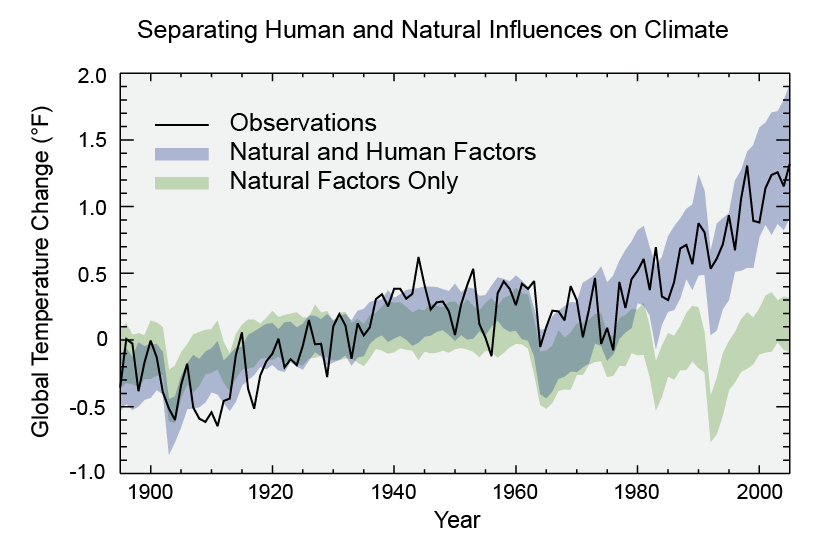
It is true that climate change occurs in natural cycles, but is also true and is documented that the warming rate of our planet has increased 1.5 degree in the last 150 years. That is when industrialization started. ( Petroleum became a major industry following the oil discovery at Oil Creek Pennsylvania in 1859)


The global temperature today is 15 c. Scientist are saying that natural fluctuation is now being overtaken by rapid human activities  and has serious implications on the climate of the planet.


Gases released from agriculture and industrial activities are adding the greenhouse effect. Cars and aero planes , deforestation and other human activities are contributing to the CO2  problem.


Since the industrial revolution ( 1750), CO2 levels have risen by more than 30% and methane levels more than 140%. The concentration of CO2 in the atmosphere is now higher than any time in the last 800,000 years” .  From http://www.bbc.co.uk/news/science-environment-24021772 .


 These facts can only emphasize the connection of human activities and climate changes.


The economic system we have today has having an impact on the planet resources as demand of productivity and products is increasing year after year. This is due to some developing countries picking up speed in the  industrialization and joining the consumeristic society. Countries like China has now embraced the modern life style of some  western countries and as the number of the population in the world increases, so will be the demand of goods and resources. This demand consequently will increase the production by increasing the consumption of fossil fuel. Renewable energy is at the moment insufficient to create enough power to run the society we know today.


It will be complicated and difficult to replaced oil and coal. Coal is still  producing a lot of electricity although even China has reduced its production in the last 3 / 4 years.


Despite its poor environmental credentials, coal remains a crucial contributor to energy

supply in many countries. Coal is the most wide-spread fossil fuel around the world, and

more than 75 countries have coal deposits. The current share of coal in global power

generation is over 40%, but it is expected to decrease in the coming years, while the actual

coal consumption in absolute terms will grow. Although countries in Europe, and to some

extent North America, are trying to shift their consumption to alternative sources of energy,

any reductions are more than offset by the large developing economies, primarily in Asia,

which are powered by coal and have significant coal reserves. China alone now uses as

much coal as the rest of the world”. ( world energy.org)


Hydropower produces 15 % of electricity in the world but if we look at the total primary supply of energy resources from 1993 to the projected 2020 we realize how fossil fuel still has huge impact in the modern world.


1993  Renewable 10% ; Hydro (other than larger hydro) 2% ; nuclear 6% ; Fossil 82%


2020 Renewable 16% ; Hydro ( as above)  2% ; nuclear 6% ; fossil 76%


As the fossil fuel are the main cause of the problem, it will be difficult for politician to take a more drastic action in reducing these highly polluting element from the modern industrialized countries.


Establishment of energy infrastructure in the least developed countries will need a major

effort on behalf of the global energy community. It will also require political, legal and

institutional structures, which today do not exist. Rising energy demand, declining public

investment and the evolving role of the multilateral financial institutions need increased

efforts by governments to change their roles in order to create an enabling business

environment to attract private investment, both domestic and international” (worldenergy.org)


But hope is there. World energy tells us that the total resource of wind is vast; estimated to be around a million GW ‘for total land coverage. And if only 1% of this area was utilized that would correspond to the total worldwide capacity of all electricity generating.


Solar energy is the most abundant energy resource and it is available for use in its direct

(solar radiation) and indirect (wind, biomass, hydro, ocean etc.) forms. About 60% of the

total energy emitted by the sun reaches the Earth’s surface. Even if only 0.1% of this energy

could be converted at an efficiency of 10%, it would be four times larger than the total world’s

electricity generating capacity of about 5 000GW”.


These resources are available and clean or cleaner than any other resources we use at the moment. The technology is there and is improving all the time. It will improve faster if investment  was  more courageously  put forward and obstacles from big fossil fuel companies was avoided. But the crises we are facing today is so great that relaying on technology and renewables is not enough. We need to change how we live and step back in the way we consume and waste. Our habits have to change. Consume less and waste less. Produce the technological goods we like to last and not to be replaced  just after few months.


From the scientific community we have been warned many times that we are getting close to a point of no return.


Even the Pope ( Francis) has written an encyclical about the problem( first time ever that a Pope embraces the problem so openly criticising the capitalistic system as the main reason for what is causing).  But many others, from writers, philosophers, singers and including politicians ( see Al Gore documentary “ the inconvenient truth”) are awaking  and trying to change things.


We know today better  than in the past what impact  is having the human interaction and abuse of nature, the planet and its resources. Is the way we use and abuse the planet that will eventually kill civilisation  if we do not act. As someone said “ there is no planet B”. I would say, there has to be a plan B to save the only one where we can live. Human intelligence has the capacity to solve the problem but so far we are using it in a destructive way. It is now the time to change. It is still not late to change.


Something interesting  as a new trend:
http://www.bbc.co.uk/bbcthree/article/237c63d4-0a54-406a-ae51-ad677a872456?intc_type=singletheme&intc_location=bbcthree&intc_campaign=bbcthree&intc_linkname=article_plogging_contentcard33


November well on the way

 Summer has left us.Temperature has dropped around 15 degrees since last week, the first week of October. Some heavy clouds have replaced th...